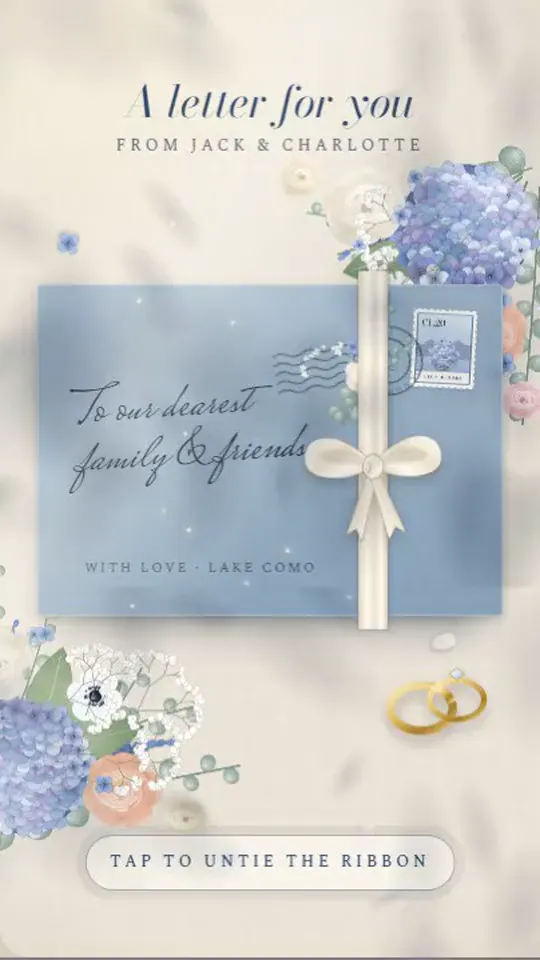
Good wedding invitation wording answers five questions in a fixed order: who is hosting, who is getting married, when, where, and what happens afterward. Once those lines are in place, the tone comes from a few small choices, like "honor" versus "pleasure" and spelled-out dates versus numerals.
Below are samples you can copy for formal, casual and modern invitations, then wording for every hosting setup, from one set of parents to the couple hosting on their own. In the samples, a slash marks a line break.
What is the standard order of wedding invitation wording?
The traditional order is the host line, the request line, the couple's names, the date and time, the location, and a reception line. Dress code, registry and hotel details belong on a details card or your wedding website, not on the invitation itself.
- Host line. Who is inviting: one or both sets of parents, the families together, or the couple.
- Request line. "Request the honor of your presence," "request the pleasure of your company," or a casual "invite you to celebrate."
- Names. Full names on formal invitations, first names (or first and last) on casual ones.
- Date and time. Spelled out on formal invitations, numerals on casual ones.
- Location. The venue name, then city and state. A street address is only needed if the venue is hard to find.
- Reception line. One short line, such as "Reception to follow."
Should it say "honor of your presence" or "pleasure of your company"?
Traditionally, "request the honor of your presence" is used for a ceremony in a house of worship, and "request the pleasure of your company" for any other venue, as WeddingWire's wording guide explains. Casual invitations can skip both and say "invite you to celebrate" or "joyfully invite you."
Most guests won't notice which phrase you pick. Your officiant or an older relative might, so it's worth getting right on a formal invitation.
Formal wedding invitation wording
This is the classic layout when one partner's parents host and the ceremony takes place in a church, synagogue or other house of worship. Dates, years and times are written out in words.
Mr. and Mrs. Robert Hale / request the honor of your presence / at the marriage of their daughter
Claire Elizabeth / to / Daniel James Ortiz
Saturday, the twelfth of June / two thousand twenty-seven / at four o'clock in the afternoon
Saint Mark's Church / Charleston, South Carolina
For a ceremony at a hotel, garden or vineyard, swap the request line for "request the pleasure of your company" and keep everything else the same. If dinner follows at the same place, add "Reception to follow" as the last line.
Wording for every hosting setup
The host line is where most couples get stuck, because real families and budgets rarely match the old templates. Pick the version that reflects who is actually hosting.
Both sets of parents
Mr. and Mrs. Robert Hale / and / Mr. and Mrs. Luis Ortiz / request the pleasure of your company / at the marriage of their children
Claire Elizabeth Hale / and / Daniel James Ortiz
Divorced or remarried parents
Give each household its own line, without "and" joining them, and put a stepparent on the same line as the parent they're married to.
Ms. Laura Bennett / Mr. and Mrs. Robert Hale / request the honor of your presence / at the marriage of their daughter
The couple with their families
Together with their families / Claire Hale and Daniel Ortiz / invite you to celebrate their marriage
The couple hosting on their own
Claire Hale and Daniel Ortiz / request the pleasure of your company / at their marriage
Honoring a parent who has died
Mention the parent next to their child's name rather than in the host line, using "the late."
Claire Elizabeth Hale / daughter of Laura Hale and the late Robert Hale / and / Daniel James Ortiz
Casual and modern wedding invitation wording
Casual wording drops titles and middle names, uses numerals, and sounds the way you talk. It suits barns, backyards, restaurants and most digital invitations.
- Warm and simple: "Claire and Daniel are getting married! Join us for dinner, dancing and a few happy tears on Saturday, June 12, 2027, at 4:00 p.m. The Glass Barn, Asheville, North Carolina."
- Joyful: "With joyful hearts, Claire Hale and Daniel Ortiz invite you to their wedding. Saturday, June 12, 2027, at 4:30 p.m. Riverside Gardens, Portland, Oregon."
- Short, for a text or digital invitation: "You're invited to the wedding of Claire and Daniel. Saturday, June 12, 2027, 4 p.m., The Glass Barn, Asheville. Please RSVP by May 15."
- Playful: "After eight years, two apartments and one very patient dog, Claire and Daniel are making it official. Come celebrate with us on June 12, 2027."
How do you write the date and time on a wedding invitation?
On a formal invitation, spell out the day, date, year and time, as in "Saturday, the twelfth of June, two thousand twenty-seven, at half past four o'clock," and write "in the afternoon" or "in the evening" instead of "p.m." On a casual invitation, numerals such as "Saturday, June 12, 2027, at 4:30 p.m." are perfectly correct.
| Element | Formal | Casual |
|---|---|---|
| Request line | request the honor of your presence | invite you to celebrate |
| Names | Full names, with middle names | First names, or first and last |
| Date | Saturday, the twelfth of June | Saturday, June 12 |
| Year | two thousand twenty-seven | 2027 |
| Time | half past four o'clock in the afternoon | 4:30 p.m. |
| Reception line | Reception to follow | Dinner and dancing to follow |
What goes on the reception line?
If the reception happens right after the ceremony at the same venue, one line covers it: "Reception to follow," "Dinner and dancing to follow," or "Festivities to follow." If it's at a different place or time, put those details on a separate reception card or in a second section of a digital invitation.
Hosting only the reception, or a party after a private ceremony, takes slightly different wording. See reception-only invitation wording for examples.
What to leave off the invitation
- Registry details. Put them on your wedding website. A gift mention on the invitation itself still reads as a request.
- "No kids" in capital letters. Address the invitation only to the people invited instead. Our guide to adults-only wedding wording has kinder phrasing.
- Plus-one confusion. Whether someone may bring a date is shown by the names you write, not by a line in the invitation text. See plus-one etiquette.
- RSVP details. On paper they go on the reply card. Our RSVP deadline and wording guide has samples for cards, websites and texts.
Does the wording change for a digital invitation?
No. The same lines go in the same order; only the details card changes, becoming a section guests scroll to instead of a separate piece of paper. Formal wording looks just as right on a screen as on cardstock.
If you're building yours on dnvit, you can write and preview the whole invitation free and pay only when you publish. When your wording is ready, try it on one of the wedding invitation designs.
Frequently asked questions
Is it "honor" or "honour" on a wedding invitation?
American invitations normally use "honor." Some couples choose the British "honour" for a traditional look, which is fine as long as you use the same spelling throughout, including "favour" on the reply card.
Do you use "to" or "and" between the couple's names?
Traditional invitations hosted by one partner's parents use "to," as in "their daughter Claire Elizabeth to Daniel James Ortiz." When both families or the couple host, "and" is the usual choice, and either is correct.
Should the invitation include the venue's street address?
Formal invitations usually show only the venue name, city and state. Put the street address on a details card, your website or a map link in a digital invitation, especially if the venue is new to most guests.
Can we write "no gifts, please" on the invitation?
It's kinder to leave gifts off the invitation entirely and say it on your website or by word of mouth. Guests who wonder will find the answer there, and nobody feels told what to do.